

No products in the basket.
A glass balustrade can look perfect on a seaside deck. It keeps the view open, brings in more light, and gives the space a cleaner finish than many timber or metal alternatives. Yet coastal projects ask much more from a balustrade system than an inland garden deck does.
Salt in the air, stronger winds, damp conditions, and faster corrosion all put pressure on materials, fixings, and maintenance. A system that performs well in an ordinary setting may age much faster near the coast. That is why the best glass balustrade for a seaside deck is rarely the cheapest option on paper.
Before ordering, homeowners, installers, and specifiers need to look at more than appearance alone. The right answer depends on exposure, fixing method, metal grade, glass specification, and how much maintenance the site owner is willing to take on. Suppliers such as Balustrade Superstore can support projects with glass balustrade systems, components, and practical guidance across different outdoor applications.
Coastal conditions change the performance question
A glass balustrade on a deck near the sea is dealing with a harsher environment from day one. Salt-laden air settles on exposed metalwork. Wind speeds can be higher and more unpredictable. Moisture sits on surfaces for longer. Timber subframes and fixings may also move more over time if the overall deck structure is not detailed well.
That means performance is not only about whether the balustrade looks good when it is installed. It is about whether the system keeps its appearance, structural reliability, and ease of maintenance after years of coastal exposure.
Main coastal stress factors to consider
- Salt spray and airborne chlorides
- High winds and gust loading
- Persistent moisture and damp air
- Faster corrosion of lower-grade metal components
- Greater cleaning and maintenance demands
- Movement in timber decking structures
- Exposure on open clifftop or beachfront sites
A deck tucked behind other buildings may face milder exposure than one directly overlooking the sea. That difference matters when choosing the system.
Start with the deck structure before choosing the balustrade
The first decision should not be the handrail shape or the style of glass clamps. It should be the structure the balustrade is fixing into.
A coastal balustrade is only as reliable as the deck edge, supporting frame, and fixing detail behind it. If the deck is timber, the quality of the joists, posts, edge beams, and brackets matters greatly. If it is a steel or concrete structure with a deck finish above it, that creates a different set of fixing options.
This point is often missed. Buyers focus on the visible glass and metal, though long-term performance depends heavily on what sits underneath.
Questions worth asking early
- Is the deck timber, steel, concrete, or mixed construction?
- Is the balustrade fixing into the top surface or the side of the structure?
- Is the deck in a sheltered bay or fully exposed to open sea winds?
- How close is it to direct salt spray?
- Is the project domestic or commercial?
- Will the deck framing move or settle over time?
- How easy will it be to clean and inspect the system?
Once those points are clear, the best system becomes easier to judge.
The main glass balustrade systems used on seaside decks
Most seaside deck projects tend to fall into three broad system types. Each can work well, though they perform differently depending on exposure and maintenance planning.
Post-and-rail glass balustrades
This is one of the most common outdoor systems. Posts are fixed at intervals along the deck edge, with glass infill panels between them and a top rail above.
For many coastal decks, this can be a practical choice. The system is familiar, adaptable, and often easier to install than a frameless channel setup. It can also allow easier replacement of individual parts if a component becomes damaged or heavily weathered.
Frameless base channel systems
This system fixes the glass into a base shoe or channel, usually creating a more minimal appearance with fewer vertical elements interrupting the view.
On a seaside deck, the look can be excellent. Still, the performance depends heavily on the substrate, drainage, fixing accuracy, and corrosion resistance of the channel and fixings. A poorly detailed frameless system can become difficult to maintain in harsh coastal conditions.
Glass balustrades with stand-off or side-fix brackets
This approach mounts the glass from the side of the structure using stainless steel stand-offs or brackets. It can create a clean appearance and help preserve deck walking width.
It works best where the deck edge and supporting frame have been designed properly to receive side loads. On exposed coastal decks, the fixing detail needs especially careful attention.
Comparison table: which seaside deck system usually performs best?
| System type | Main strengths | Main risks in coastal use | Best suited to |
| Post-and-rail glass balustrade | Practical, adaptable, easier to maintain and adjust | More visible metalwork to clean and protect | Most domestic decks, holiday lets, general coastal projects |
| Frameless base channel | Strong visual impact, low interruption to the view | Needs excellent drainage, substrate quality, and premium corrosion resistance | High-spec coastal terraces and premium residential projects |
| Side-fix or stand-off system | Preserves deck width, clean appearance | Fixing detail is critical and exposed edges need robust engineering | Steel-framed decks or projects designed around side fixing from the start |
For many seaside decks, a well-specified post-and-rail system often gives the best balance of durability, serviceability, and cost. That answer can change if the design priority is a highly minimal look and the structure is strong enough for a frameless or side-fixed approach.
In many coastal settings, post-and-rail systems are the safest all-round choice
For a large number of domestic and light commercial seaside decks, post-and-rail glass balustrades are often the most dependable option.
The reason is simple. They are generally more forgiving than frameless systems, easier to inspect, and easier to maintain over time. If a coastal site is taking regular wind and salt exposure, having a system with accessible components can be a major advantage.
This does not mean every post-and-rail system is suitable. Material grade, fixing quality, and glass specification still matter. A low-grade system can still deteriorate quickly near the coast. Yet as a format, post-and-rail tends to cope well with the realities of outdoor deck movement and ongoing maintenance.
Frameless systems can work well, but the detailing has to be right
A lot of buyers are drawn to frameless glass because it gives the clearest possible sea view. On the right project, that can be a strong choice.
The challenge is that coastal exposure puts more pressure on every hidden detail. The base channel, anchors, drainage paths, packers, and interface with the deck finish all need to be considered carefully. Water and salt should not be trapped where they can accelerate corrosion or make cleaning difficult.
A frameless system on an exposed seaside deck is therefore best treated as a premium engineered option, not a simple style upgrade. It usually needs a better supporting structure and closer coordination than a more conventional post system.
Side-fixed systems suit some decks very well
There are also cases where a side-fixed glass balustrade becomes the strongest answer. This often happens where preserving the full deck surface is important or where the deck structure has been designed from the outset to take side-mounted brackets.
A steel-framed balcony or raised deck may suit this approach particularly well. It can create a neat visual line and keep the top surface less cluttered.
The trade-off is that coastal side fixings are exposed and need excellent corrosion resistance. The structural edge also needs to be robust enough for the loads involved. If the substrate is weak or inconsistent, side fixing becomes a riskier option.
Material choice matters as much as system choice
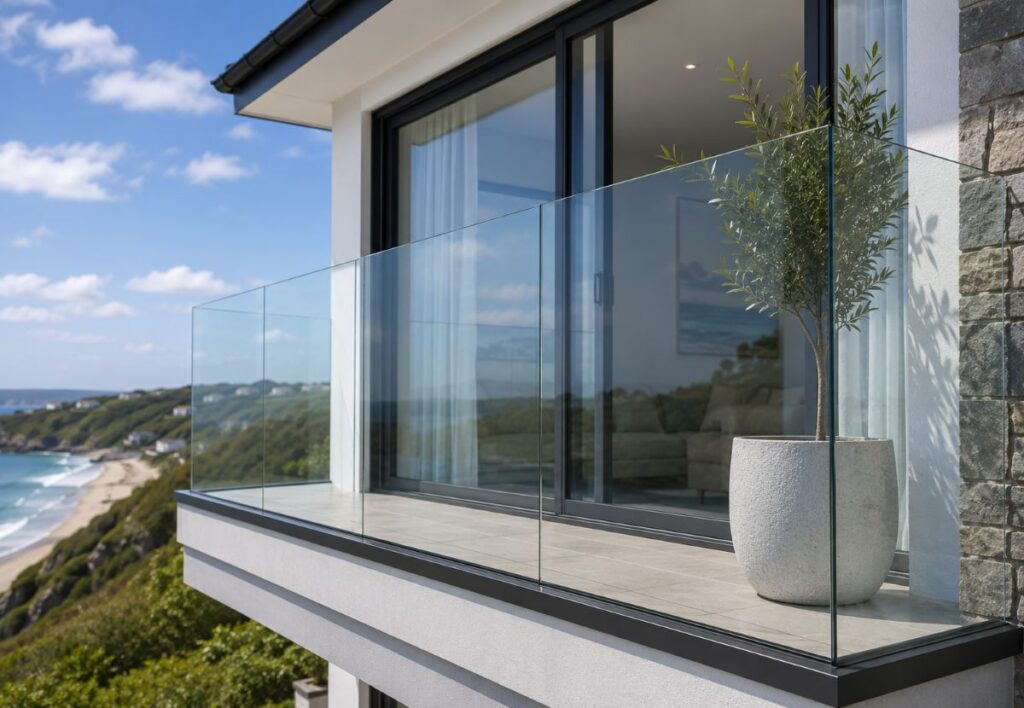
By this point, the question becomes less about style alone and more about materials. In coastal work, the wrong metal choice can shorten the life of the whole installation.
Stainless steel components are common in glass balustrade systems, though not all stainless steel performs equally in marine settings. Lower grades may show tea staining, surface corrosion, or premature deterioration far sooner in salty environments.
Key material considerations
- Stainless steel grade for posts, clamps, rails, and fixings
- Quality of powder-coated or painted components if used
- Resistance of hidden fixings and anchors, not only visible parts
- Compatibility between different metals to reduce galvanic corrosion
- Glass specification suitable for outdoor guarding use
- Durability of gaskets, packers, and seals in UV and salt exposure
Many coastal projects call for higher-grade marine-suitable stainless steel rather than the lower grades more often used inland. This is one of the clearest places where trying to save money early can lead to a poorer result later.
The fixing method often decides long-term performance
Even a well-made system can struggle if the fixing detail is wrong. Coastal decks are exposed to wind, moisture, movement, and repeated weather cycles. The balustrade fixing has to deal with all of that.
Top-fix systems need careful waterproofing and strong support below. Side-fix systems need reliable edge structure and adequate corrosion-resistant anchors. Timber decks need special care, since movement and moisture can affect alignment over time.
Common fixing issues on seaside decks
- Fixings installed into weak deck edges
- Water traps around base plates or channels
- Mixed metals causing corrosion problems
- Inadequate edge distance or timber strength
- Fixings chosen for inland use rather than marine exposure
- Poor drainage around channel systems
A professional quote should show that these details have been considered properly, not left vague.
Wind loading cannot be treated as an afterthought
On an inland patio, wind pressure may feel like a secondary issue. On a deck near the sea, it can become one of the main design considerations.
Open coastal sites can face stronger gusts and more persistent exposure than many clients expect. Deck height, orientation, and local topography can all affect loading. A raised deck on a clifftop or open shoreline is very different from a lower sheltered terrace set back from the water.
That is why the chosen balustrade system should be suitable for the expected loading and the supporting structure should be checked accordingly. This is especially important for more minimal frameless systems, where the base fixing is doing more visible and structural work.
Maintenance should be built into the buying decision
As the system choice becomes clearer, maintenance needs to stay part of the conversation. Coastal balustrades usually need more regular cleaning than inland ones.
Salt deposits can build up on metalwork and glass. If they are left for long periods, appearance suffers and corrosion risk increases. A buyer who wants the lowest-maintenance option should think carefully about how easy the system will be to wash down, inspect, and maintain over time.
Good coastal maintenance planning often includes
- Regular rinsing of exposed metalwork and glass
- More frequent cleaning on highly exposed seafront sites
- Periodic inspection of fixings and brackets
- Checking for movement in timber deck structures
- Prompt treatment of any tea staining or surface corrosion signs
- Replacing worn gaskets or seals where required
The best-performing system is often the one that suits both the environment and the owner’s willingness to maintain it.
Common mistakes when choosing glass balustrades for seaside decks
A pattern tends to appear on weaker coastal projects.
Common mistakes
- Choosing on appearance alone
- Using lower-grade components suited mainly to inland sites
- Ignoring the condition of the supporting deck structure
- Underestimating coastal wind exposure
- Treating frameless systems as simple rather than highly detail-sensitive
- Overlooking maintenance requirements
- Focusing on visible fittings but not hidden anchors and fixings
Most of these problems can be reduced by matching the system to the real site conditions rather than to a generic product image.
So which system performs best in coastal conditions?
For many seaside decks, a high-quality post-and-rail glass balustrade system is often the best all-round performer in coastal conditions. It usually offers the strongest balance of durability, serviceability, adaptability, and cost control.
That answer is especially persuasive where the deck is timber-framed, where maintenance access matters, or where the site is exposed enough to make hidden detailing more critical.
Still, that does not make post-and-rail the right answer for every project. A frameless base channel system can perform very well on a premium coastal deck if the substrate, drainage, material grade, and fixing design are all handled properly. A side-fixed system can also be excellent where the structure has been designed for it.
The best system is the one that balances exposure, structure, maintenance, visual goals, and budget without pretending that coastal conditions are mild.
Final thoughts
Seaside decks put more pressure on a glass balustrade than many buyers first realise. Salt, moisture, wind, and structural movement all make specification more important.
The strongest results usually come from starting with the deck structure, choosing a system suited to the exposure level, and paying close attention to metal grade, fixings, and maintenance planning. In many cases, that leads buyers towards a robust post-and-rail system. In others, a carefully engineered frameless or side-fixed setup may be the better fit.
The key is to choose for real coastal performance, not only for the first impression on installation day.
One of the most common mistakes is choosing a system for looks alone without checking exposure, structure, fixing detail, and long-term maintenance needs.
FAQs
Are frameless glass balustrades a bad choice for seaside decks?
No. They can work very well, though they need better detailing, strong structural support, and careful drainage in coastal conditions.
What metal grade is usually better for coastal balustrades?
Marine-suitable stainless steel is often preferred for coastal projects, especially on exposed sites. Lower grades can deteriorate faster near the sea.
Is a post-and-rail system better than frameless for a timber deck?
In many cases, yes. Post-and-rail systems are often more forgiving on timber structures and easier to maintain over time.
Do seaside glass balustrades need more cleaning?
Yes. Salt deposits and damp conditions usually mean more regular cleaning and inspection than inland installations.
Can side-fixed glass balustrades work on a coastal deck?
Yes, if the deck edge and supporting frame are strong enough and the fixings are suitable for marine exposure.
What is the biggest mistake on a coastal glass balustrade project?
One of the most common mistakes is choosing a system for looks alone without checking exposure, structure, fixing detail, and long-term maintenance needs.
Posted in Uncategorized
