

No products in the basket.
Measuring for a glass balustrade can seem simple at first, but there are a lot of variables. The type of system, the shape of the area, the fixing method, and the exact point you measure from can all affect the final specification.
That is why it helps to get the basics right early. At Balustrade Superstore, we can work from the dimensions you provide and help turn them into a suitable balustrade layout for your project.
This guide explains what to measure, where to measure from, and why the outside track matters so much.
Why Measuring a Glass Balustrade Is Not Always Straightforward
A glass balustrade is not just filling a gap. It needs to suit the space, the system, and the fixing method.
That means a few things can change how the measurements should be taken, including:
- Whether the balustrade is frameless or post and rail
- Whether it is going on a balcony, patio, deck, or terrace
- Whether the area has corners, returns, or steps
- Whether the fixing point is the deck edge, slab edge, or base plate position
- Whether the surface is level and suitable for the system
Because of those variables, measuring is usually less about guessing panel sizes and more about capturing the right outside dimensions.
Start With the Outside Perimeter
In most cases, the starting point is the outside of the perimeter where the balustrade will be fixed.
This is the key dimension we need for the balcony, patio, or other area being guarded. We often refer to this as the outside track.
The outside track gives the best reference point for working out the balustrade layout because it reflects where the system will actually sit, rather than just the clear walking space inside the area.
If the measurements are taken from the wrong point, the layout can be inaccurate from the beginning.
What Does Outside Track Mean?
Once you know the perimeter matters, the next step is understanding what the outside track actually is.
The outside track is the outside line of the balustrade fixing position. In simple terms, it is the outer dimension of where the system will run.
Depending on the system, that could mean:
- The outside edge of the frameless base rail
- The outside edge of the post base plate positions
- The outside line of the fixing run around the balcony or patio
This is the dimension that helps us understand the true run length for the balustrade.
Measuring for a Frameless Glass Balustrade
If you are measuring for a frameless balustrade system, the base rail width matters.
The frameless base rail is 75 mm wide. That means the position of that rail needs to be allowed for when measuring the outside track.
For a frameless balustrade, it is usually most useful to provide:
- The outside perimeter where the base rail will sit
- The length of each straight run
- Any corners or changes in direction
- Any gaps for steps or access
- Photos if the area has unusual details
This helps us understand how the track will work around the edge and how the glass layout should be set out.
Measuring for a Post-and-Rail Balustrade
If the system is post and rail, the measuring point changes slightly.
For post-and-rail systems, the base plate is 105 mm in diameter. In these cases, we need the outside of the base plate dimensions, because that gives the fixing line for the system.
For a post-and-rail balustrade, it helps to provide:
- The outside line of the base plate positions
- The length of each run
- Corner locations
- Start and finish points
- Any obstructions near the fixing zone
The key point is the same as with frameless systems: the outside fixing line matters more than the open internal space.
Measure Each Straight Run Separately
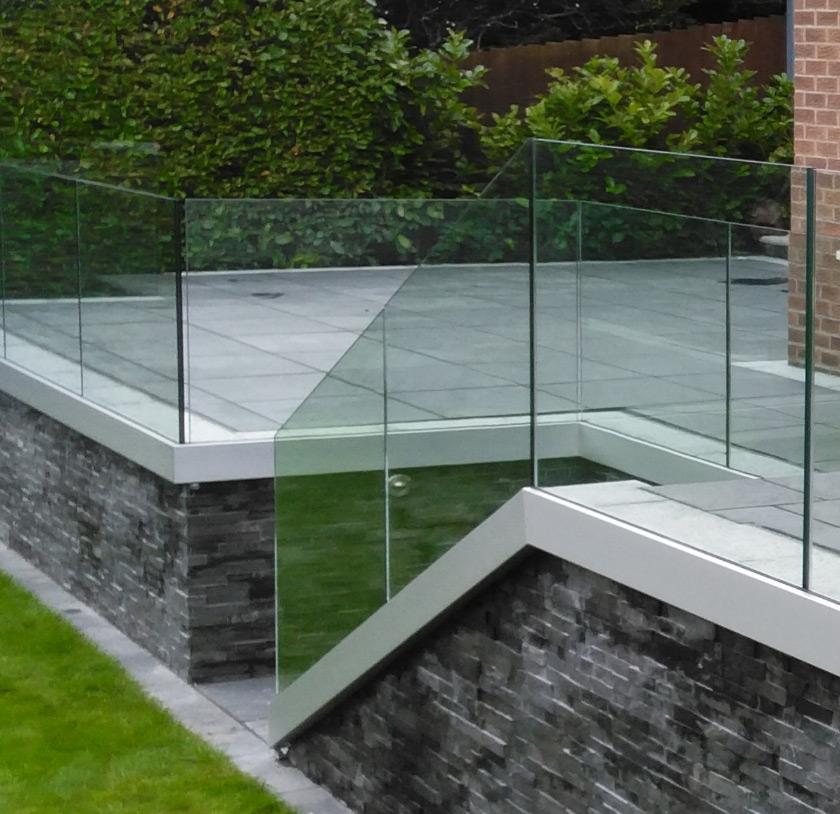
Once the outside track is clear, the best way to avoid confusion is to break the area down into straight sections.
Measure each run separately rather than trying to estimate the whole perimeter in one go. This is especially important if the balcony or patio has:
- Corners
n- Returns - Angled sections
- Steps
- Openings for access
Clear run-by-run dimensions make it much easier to work out a practical balustrade layout.
Check Corners, Changes in Direction, and Access Points
Straight lengths are only part of the picture. Corners and interruptions matter just as much.
If the balustrade changes direction, starts after a wall, stops before steps, or runs around a return, those details need to be shown clearly in the measurements or sketch.
Even a simple hand-drawn plan can help if it shows:
- The outside dimensions
- Each corner
- Where the balustrade starts and stops
- Any steps, gates, or access gaps
- Which system you are measuring for
The clearer the sketch, the easier it is to avoid mistakes later.
Check the Fixing Area Before Measuring
Because there are so many variables, it is also worth checking that the balustrade can actually be fixed where you plan to measure.
Before sending dimensions, look at:
- Whether the structure is suitable for the system
- Whether the fixing zone is wide enough
- Whether the edge is level enough
- Whether drainage or waterproofing details may affect installation
A measurement may be accurate but still not useful if it is taken from a fixing area that is not suitable in practice.
Can You Measure From Drawings?
Yes, in some cases you can.
If you already have architect drawings, builder drawings, or measured plans, we can often work from those instead of from a fresh site sketch. The most important thing is that the outside fixing dimensions are clear.
That can be especially helpful on larger or more detailed projects where the area is not a simple rectangle.
Do Balustrade Superstore Come Out to Measure?
No, Balustrade Superstore do not come out to site to measure.
Instead, you send us the dimensions, drawings, or sketch, and we use that information to help guide the specification. Because there are a lot of variables, the simplest route is often to get in touch with us early so we can explain exactly what we need for your specific system.
Common Measuring Mistakes to Avoid
A few mistakes come up regularly when people first measure for a balustrade.
These include:
- Measuring the inside edge instead of the outside track
- Forgetting to allow for the system type
- Missing corners, returns, or access gaps
- Sending one overall size without separate run lengths
- Measuring before checking whether the fixing area is suitable
- Assuming frameless and post-and-rail systems are measured in exactly the same way
Avoiding those mistakes makes the next stage much easier.
Final Thoughts
Measuring for a glass balustrade is not always as simple as taking one width and one depth. There are a lot of variables, and the correct measuring point depends on the system and the fixing line.
As a guide, the frameless base rail is 75 mm wide, while a post-and-rail system uses a 105 mm diameter base plate. In both cases, what we usually need is the outside track, meaning the outside perimeter or outside base plate dimensions where the balustrade will be fixed.
If you are unsure, the best next step is to get in touch with Balustrade Superstore. We can look at your measurements, drawings, or sketch and help you understand what is needed before you move further with the project.
FAQs
What is the outside track for a glass balustrade?
The outside track is the outside line of where the balustrade system will be fixed. It is usually the most useful measurement for working out the layout.
What width is the frameless base rail?
The frameless base rail is 75 mm wide.
What size is the post-and-rail base plate?
The post-and-rail base plate is 105 mm in diameter.
Should I measure the inside or outside of the balcony?
In most cases, you should measure the outside fixing line or outside track rather than the internal walking area.
Can Balustrade Superstore work from drawings?
Yes. If you have architect drawings, builder drawings, or other measured plans, these can often be used as long as the relevant dimensions are clear.
Do Balustrade Superstore come out to measure?
No. You will need to provide the measurements, sketch, or drawings so the project can be assessed from the information supplied.
Posted in Uncategorized
