

No products in the basket.
Toughened and laminated glass are both forms of safety glass, but they behave very differently if they break.
Toughened glass is heat-treated to increase its strength. If it does fail, it breaks into many small fragments rather than large, sharp shards. Laminated glass uses an interlayer to hold broken glass together, helping the panel remain in place after damage.
So, which is better?
For a balustrade, the answer depends on where the glass is being installed, how the system is supported and what would happen if a panel broke. For some internal applications, toughened glass can be perfectly suitable. Where a balustrade protects a fall and has no handrail, toughened laminated glass is generally the appropriate choice because it provides a secondary barrier after breakage.
What is toughened glass?
Toughened glass, sometimes called tempered glass, starts as standard glass before undergoing controlled heating and rapid cooling.
This process creates internal stresses that make the finished panel considerably stronger than ordinary annealed glass. Balustrade Superstore describes toughened glass as being up to five times stronger than ordinary glass.
Its other important characteristic is how it breaks.
Ordinary glass can produce large, dangerous shards when smashed. Toughened safety glass is designed to fragment into much smaller pieces, reducing the likelihood of serious cuts. That combination of strength and safer breakage makes toughened glass suitable for many balustrade applications.
What is laminated glass?
Laminated glass is constructed differently.
It consists of multiple layers of glass bonded together using an interlayer. If one or more layers break, that interlayer helps hold the fragments together rather than allowing them to fall away and leave an immediate opening.
That is particularly important when the glass is acting as a barrier.
Imagine a panel surrounding a raised balcony. Preventing sharp shards is important, but so is preventing a large gap from suddenly appearing where the safety barrier used to be.
Laminated construction provides this post-breakage behaviour, which is one of its biggest advantages in balustrade systems.
Toughened vs laminated glass: the key difference
The most useful way to compare the two is to ask what happens after the glass breaks.
Toughened glass is designed to break more safely, fragmenting into relatively small pieces.
Laminated glass is designed so that the interlayer retains broken fragments and helps the panel continue acting as a barrier.
This means choosing glass is not simply a question of asking which type is stronger.
You need to consider what the glass is doing within the complete balustrade system and what the consequences of failure would be.
Is toughened glass stronger than laminated glass?
This question can be misleading because “laminated” describes how layers are bonded together, while “toughened” describes a strengthening process.
You can have toughened laminated glass, which combines toughened glass layers with a laminated construction.
Balustrade Superstore supplies both toughened safety glass and toughened laminated safety glass for its balustrade systems.
That means the decision is not necessarily between having strength or having lamination.
Toughened laminated glass can provide the impact resistance associated with toughened glass alongside the residual barrier provided by the interlayer if breakage occurs.
When is toughened glass suitable for a balustrade?
Toughened glass can be appropriate where strength and impact resistance are required but the installation does not rely on the panel remaining in place after breakage.
One common example is an internal residential balustrade system where the glass has been correctly specified for the application and supported within an appropriate system.
It can also be used in some commercial internal guarding applications, subject to the relevant loading, design and installation requirements.
However, you should never select a panel simply because it is labelled “toughened safety glass”.
Glass thickness, panel dimensions, fixings, supporting structure and the balustrade design itself all influence whether the complete installation is suitable.
When is toughened laminated glass the better choice?
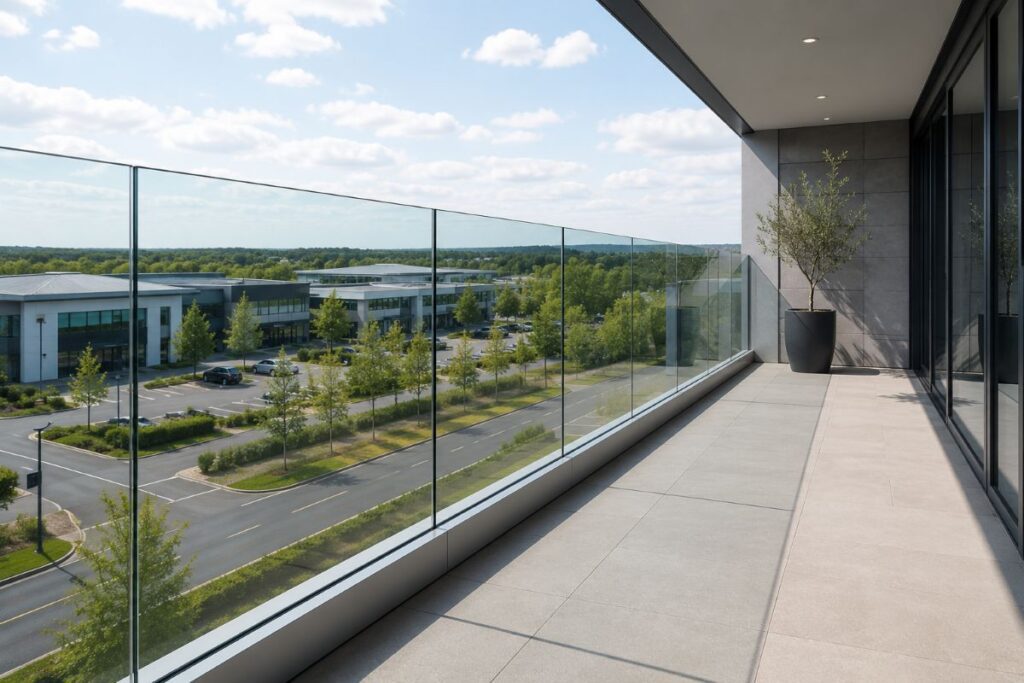
Laminated glass becomes particularly important when the balustrade is protecting people from a fall.
Balustrade Superstore specifies that when a frameless balustrade without a handrail is protecting a fall, the relevant laminated glass should be used, because it provides a secondary barrier if one of the glass panes fails.
Applications can include:
- Balconies
- Raised terraces
- Elevated decking
- Other frameless barriers protecting a drop
The key issue is residual protection.
If a panel is damaged, the interlayer helps prevent the glass immediately disappearing from the opening. That makes laminated construction especially valuable where the consequences of losing the barrier could be severe.
What about glass balustrades with a handrail?
The complete balustrade design matters.
A system incorporating posts, rails or a continuous handrail behaves differently from a frameless system where the glass itself forms a major part of the barrier.
That is why it is risky to choose glass thickness and construction without considering the system it will be installed into.
Balustrade Superstore supplies different glass specifications for different systems, including toughened panels for post-and-rail applications and thicker toughened or toughened laminated panels for other balustrade designs.
The correct glass should therefore be selected alongside the balustrade system rather than as a separate decision.
Does location make a difference?
Yes.
An internal staircase, a ground-level patio screen and a first-floor balcony do not present the same consequences if glass is damaged.
For internal residential staircases and landings, correctly specified toughened glass can be suitable. For raised external balconies and terraces where there is a fall risk, laminated glass is typically the safer specification because of its ability to retain broken glass.
Ground-level installations may offer more flexibility because there may be little or no fall risk behind the barrier.
Rather than deciding based purely on whether the project is indoors or outdoors, consider what is on the other side of the glass.
What standards apply to balustrade glass?
Safety glass for balustrades needs to form part of a system that meets the relevant requirements for its location and use.
Balustrade Superstore identifies several important standards, including:
- BS EN 12150 for toughened safety glass
- BS EN 14449 for laminated safety glass
- BS EN 12600 for impact performance classification
- BS 6180 for barriers in and about buildings
Approved Document K of the Building Regulations in England also covers protection from falling, collision and impact.
Requirements can vary according to the installation. A domestic staircase and a busy commercial area, for example, may be subject to different design loads.
This is another reason not to select glass based on thickness alone.
Is laminated glass more expensive?
Toughened laminated glass will generally involve more material and manufacturing than a single toughened panel, so it can cost more.
But price should follow specification rather than determine it.
If the installation requires laminated glass to provide the appropriate residual protection, choosing a cheaper toughened-only panel is not a genuine saving.
The better way to control costs is to select a balustrade system and glass specification that are appropriate for the project from the beginning. Changing unsuitable glass after ordering — or worse, after installation — can be considerably more expensive.
Which glass should you choose?
There is no universal winner between toughened and laminated glass.
Toughened glass may be suitable when:
- The installation is correctly designed to use it
- Impact resistance is required
- There is no requirement for the panel itself to remain as a barrier after breakage
- The glass is being used within an appropriate supported system
Toughened laminated glass is generally the better choice when:
- The balustrade protects a fall from height
- A frameless system has no handrail
- Maintaining a barrier after breakage is important
- The project’s specification requires laminated safety glass
Balustrade Superstore supplies toughened and toughened laminated safety glass alongside frameless, post-and-rail and other balustrade systems, so the glass can be selected around the requirements of the complete installation.
Final thoughts
Toughened and laminated glass solve different safety problems.
Toughened glass provides increased strength and breaks into smaller fragments if it fails. Laminated glass uses an interlayer to retain broken glass and help maintain the barrier after damage.
For balustrades, that post-breakage performance can be crucial.
Instead of asking which glass is “better” in isolation, consider the location, fall risk, balustrade system and relevant regulations. Once those factors are clear, the correct glass specification becomes much easier to identify.
FAQs
What is the main difference between toughened and laminated glass?
Toughened glass is heat-treated for additional strength and breaks into small fragments when it fails. Laminated glass uses an interlayer that helps hold broken fragments in place.
Is toughened glass safe for balustrades?
Yes, toughened safety glass can be suitable for certain balustrade systems and locations when correctly specified. It is not appropriate for every application.
Do frameless balustrades need laminated glass?
Where a frameless balustrade without a handrail is protecting a fall, Balustrade Superstore specifies the relevant laminated glass because it provides a secondary barrier if a pane fails.
What is toughened laminated glass?
Toughened laminated glass combines layers of toughened glass with an interlayer. This provides the strength of toughened glass while helping the panel remain together after breakage.
Which glass is best for a balcony?
For raised balconies where the balustrade protects against a fall, toughened laminated glass is commonly appropriate because of its residual protection after breakage. The exact specification should match the complete system and project requirements.
Can I choose balustrade glass based on thickness alone?
No. Thickness is only one factor. The system design, panel dimensions, supports, loading requirements, location and fall risk all need to be considered.
Posted in Uncategorized
