

No products in the basket.
Introduction
Wire rope balustrades are becoming increasingly popular across the UK for balconies, raised decking, garden terraces and outdoor living areas. Often marketed as a stylish, low-cost alternative to glass balustrades, these systems typically feature multiple horizontal stainless steel cables tensioned between supporting posts.
But behind the minimalist appearance lies a serious question: Are some homeowners unknowingly installing what amounts to a climbing frame at the edge of a dangerous drop?
At Balustrade Superstore, we believe the potential safety risks associated with horizontal wire rope balustrades deserve much greater scrutiny, particularly where young children may be present. There are three areas of particular concern: climbing, entrapment and cable deflection.
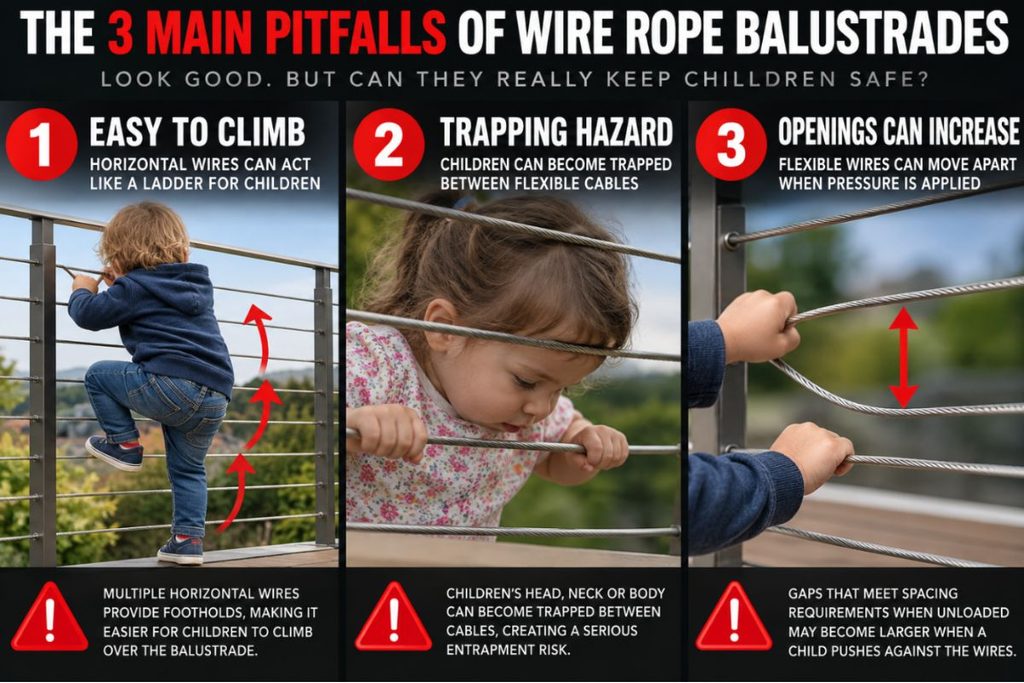
1. The Climbing Hazard: To a Child, Horizontal Wire Ropes Can Look Like a Ladder
Imagine a young child playing on a raised decking area or first-floor balcony. In front of them is a series of horizontal stainless steel cables, positioned one above another. To an adult, these cables may appear to form an attractive, contemporary barrier. To a child, they may look like ladder rungs.
Each horizontal cable can potentially provide a foothold or handhold, allowing a child to climb progressively higher. On an elevated balcony, terrace or raised deck, the consequences of climbing over protective guarding could be catastrophic.
England’s Approved Document K specifically addresses the avoidance of horizontal rails or other features that facilitate climbing in guarding where young children may be present. Would you deliberately install a ladder at the edge of your first-floor balcony?
2. Child Entrapment: Could a Child Become Trapped Between Wire Ropes?
Unlike a continuous glass panel, a horizontal wire rope balustrade contains multiple openings between flexible cables. A child attempting to squeeze through these openings may apply pressure that causes adjacent wires to move apart.
Depending on the tension, cable spacing, unsupported span and fixing arrangement, this movement could create an opening large enough for part of a child’s body to enter. Potential hazards include head or neck entrapment, partial passage through the barrier, the torso becoming caught between wires, and loss of balance while climbing or squeezing through.
A balustrade should prevent access to a dangerous drop, not introduce avoidable opportunities for children to become trapped. Where is the evidence demonstrating that the complete wire rope system adequately addresses these foreseeable risks?
3. Cable Deflection: Why a 99mm Gap May Not Stay 99mm
The initial spacing between adjacent wires alone does not establish how a flexible barrier will perform in use. When pressure is applied, one cable may move upwards while another moves downwards, increasing the effective opening.
Movement depends on cable tension, cable construction, the distance between supporting posts and the stiffness of fixings. A stainless steel cable can be strong in tension while still allowing sideways movement. A child does not need to break a cable to encounter a hazard.
4. Do Wire Rope Balustrades Comply With UK Building Regulations?
In England, Approved Document K provides guidance on protection from falling, collision and impact. Paragraph 3.3 addresses guarding in buildings that may be used by children under five, including the avoidance of horizontal rails that facilitate climbing and guidance on openings preventing passage of a 100mm diameter sphere, subject to relevant exceptions.
BS 6180 provides recommendations for barriers in and around buildings, including structural performance and loading considerations. Quoting the breaking strength of a stainless steel cable does not necessarily demonstrate that the complete protective barrier is suitable. The complete system, supporting structure, fixings and intended application must be considered. Approved Documents are guidance; alternative approaches may demonstrate compliance.
5. The DIY Wire Rope Balustrade Problem
Wire rope balustrade kits are often marketed as straightforward DIY installations. Yet performance depends on correct cable tensioning and suitable structural supports. Insufficient tension can increase movement; excessive tension can impose substantial forces on posts and fixings. Timber movement, loose fittings and changes in tension over time may also affect performance. A safety-critical barrier should never depend on guesswork.
6. An Alternative: Frameless Glass Balustrades
For homeowners concerned about climbing and entrapment hazards, a properly specified frameless glass balustrade offers a different protective barrier. Continuous glass infill removes the ladder-like arrangement created by horizontal cables and the flexible gaps between them.
Balustrade Superstore supplies frameless glass balustrade systems for balconies, raised decking, patios, terraces and commercial projects, including Sabco aluminium base-channel systems. Options may include base-fixed arrangements, suitable safety glass specifications and project-specific technical support.
Correct glass specification, fixing design and structural verification remain essential. Explore: https://balustradesuperstore.co.uk/frameless-glass-systems/
7. Another Alternative: Stainless Steel Post and Handrail Balustrades With Glass Infill
A fully frameless system is not the only option. Stainless steel post and handrail balustrades with glass infill replace multiple horizontal wires with continuous glass panels supported by posts and clamps. This avoids the series of cable footholds and flexible openings discussed above.
Balustrade Superstore offers stainless steel post and rail glass balustrade systems, including 42.4mm diameter post options and matching handrails. Applications may include raised garden decking, residential balconies, outdoor terraces and internal areas, subject to correct specification.
Explore: https://balustradesuperstore.co.uk/shop/balustrade-post-rail-kit/
8. Frameless Glass vs Wire Rope vs Post-and-Rail Glass
| Safety consideration | Horizontal wire rope | Frameless glass | Post & rail glass |
| Horizontal cable footholds | Potentially present | Absent | Absent within glass infill |
| Flexible openings between wires | Potentially present | Absent | Absent within glass infill |
| Cable tension maintenance | Required | Not applicable | Not applicable |
| Structural design verification | Required | Required | Required |
| Elevated guarding suitability | Design dependent | Specification dependent | Specification dependent |
9. Our Challenge to the Wire Rope Balustrade Industry
Can children climb the horizontal cables? Could a child’s head, neck or body become trapped between the wires? How far do the cables move under pressure? Has the complete system been assessed against the relevant structural requirements? Is the installation suitable for its intended use on a UK balcony or raised deck?
We are not claiming every wire rope balustrade is unsafe or non-compliant. But when a product is promoted as protective guarding, the evidence supporting its suitability should be readily available.
10. Choosing a Balustrade for Your Balcony or Decking Project
If you are considering a new balcony balustrade, glass decking balustrade or replacement for an existing wire rope system, consider both frameless glass and stainless steel post-and-rail systems with glass infill. Balustrade Superstore can help homeowners, architects, developers and installers consider suitable products based on project dimensions, required loading and supporting structure. Protective guarding should be selected on safety, suitability and engineering, not simply appearance or initial cost.
Final Thought: A Balustrade Is Not a Climbing Frame
A balustrade is a safety-critical part of a building. Its purpose is to help prevent people falling from height. It should not introduce unnecessary climbing opportunities or potentially hazardous openings.
Because children don’t understand cable tension, structural calculations or Building Regulations. They simply see something they can climb. And that should concern every responsible homeowner, architect, installer and supplier.
Looking for an Alternative to Wire Rope Balustrades?
Balustrade Superstore | https://balustradesuperstore.co.uk | sales@balustradesuperstore.co.uk
Technical note: This article discusses potential safety risks associated with certain horizontal wire rope balustrade arrangements. Actual performance and compliance depend on complete system design, installation and intended use. References to Approved Document K concern England; other UK nations have separate requirements.
Posted in Uncategorized
