

No products in the basket.
Glass Balustrades in UK Homes, Safety & Compliance
At Balustrade Superstore, we believe a glass balustrade should do more than just look good — it must meet rigorous safety standards and be fully compliant with UK building regulations. Whether you’re planning a balcony, staircase or mezzanine, it’s vital to ensure your design meets the rules as well as your aesthetic expectations.
When Does a Balustrade Become Necessary?
According to current regulations (Approved Document K and BS 6180:2011 — the Code of Practice for barriers in and around buildings), a protective barrier must be provided wherever there is a risk of falling from one level to another. In a typical home, this means any staircase, landing, mezzanine, balcony or raised area where the difference in floor height is more than 600 mm must be guarded.
Even if you believe a drop is “small,” 600 mm is considered enough to pose a real hazard — especially for children, older members of the household, or visitors unfamiliar with the space. As such, we always recommend erring on the side of safety when in doubt.
What Are the Minimum Height Requirements For Glass Balustrades?
Regulation varies depending on where in the property the balustrade is installed:
- For internal staircases, landings, mezzanines and other internal level-changes within a single-family dwelling, the minimum height required is 900 mm from the finished floor (or pitch line of a staircase) to the top of the barrier or handrail.
- For external areas — such as balconies, terraces, roof edges, or any outdoor platform with a drop — the minimum height rises to 1100 mm.
It’s important when measuring to use the correct “datum” (the final walking surface / finished floor level), and not structural parts beneath flooring or joists — otherwise the guard may end up too low to comply.
What Kind of Glass Is Acceptable?
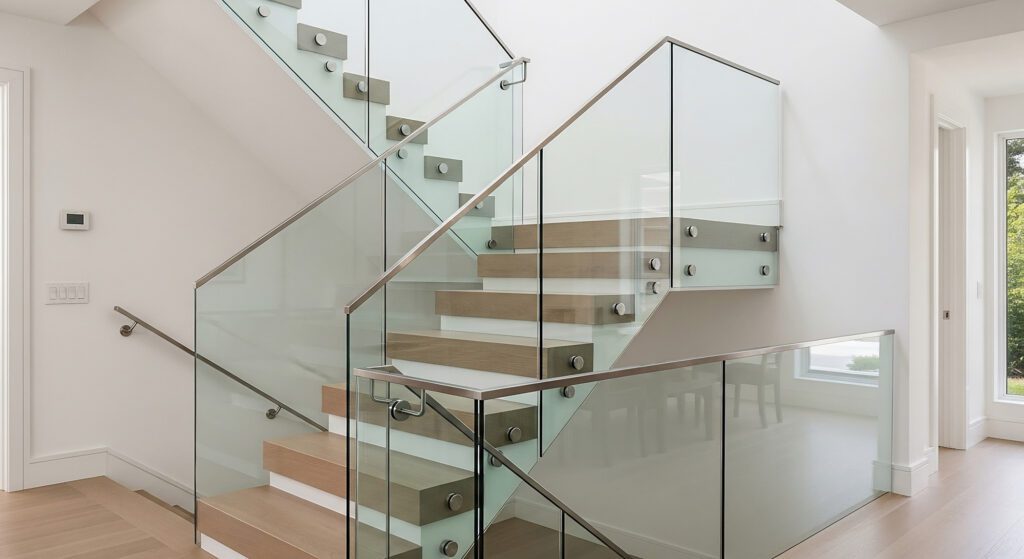
Not all glass is equal when it comes to safety. BS 6180 sets strict requirements for glass used in balustrades. For domestic settings, typical guidance is:
- If you use a fully framed or post-and-rail system with infill panels, it’s usually acceptable to use toughened safety glass normally 10mm or 12mm thick toughened glass.
- If you prefer a frameless “all-glass” design (no visible top rail), you should use toughened and Laminated glass, typically combining two or more panels with an interlayer. That way, if one panel is damaged, the interlayer keeps the glass intact, maintaining the barrier. We have tested solutions using both 17.5mm and 21.5mm dependant on loading and applications .
For anything where failure of a single pane would compromise safety — e.g. balconies, roof edges, child-accessible landings — laminated glass is strongly advised (and often required). At Balustrade Superstore, we only supply glazing systems that meet or exceed these standards.
Load, Strength & Structural Safety — It’s Not Just About Height
Height and glass type are only part of what makes a balustrade safe. The barrier must also withstand loads and impacts. As defined by BS 6180:2011 and related standards, a balustrade in a domestic setting must resist a minimum uniformly distributed line load of 0.36 kN or 0.74 Kn depending on situation and location of the barrier.
Importantly, if your design uses infill glass panels (even with posts or channels), those fixings must be correct — clips or bolts must be appropriately spaced, positioned, and installed so the glazing retains integrity under load.
If you’re opting for frameless glass panels — note that though the regulations now allow “no handrail” systems, that is only safe when the glass is laminated toughened and the fixings and structural calculations back up the design.
Beyond the Minimum: Why We Recommend Exceeding Regulations
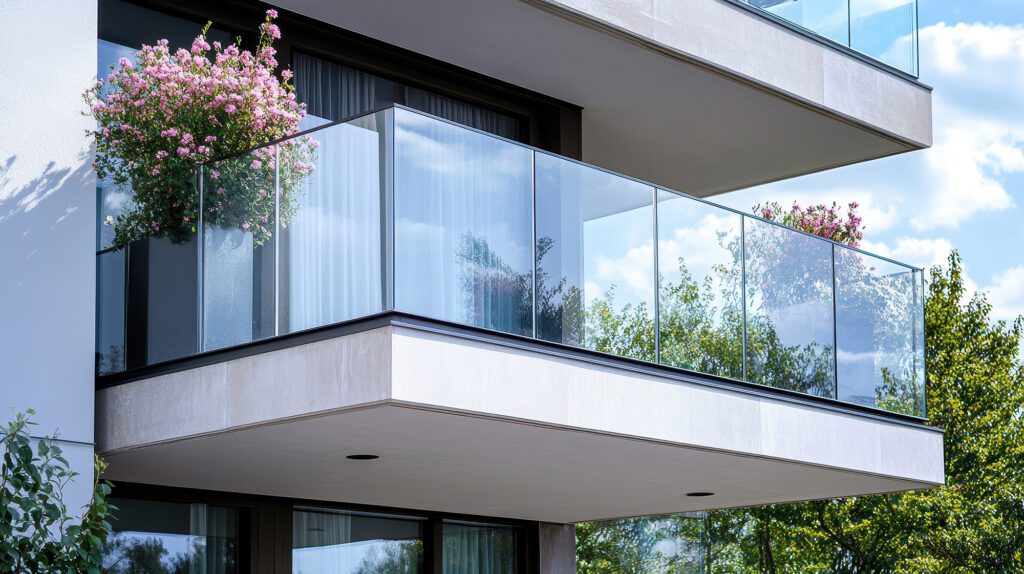
From our experience working with homeowners across the UK, we believe it’s wise to treat building regulations as the starting point, not the finish line. Many of our customers choose to exceed minimum requirements for extra safety, longevity and peace of mind.
- For internal landings or stair voids, we often recommend balustrades up to 1000 – 1100 mm, even though 900 mm is the legal minimum — increased height offers a stronger sense of protection, without compromising design.
- For glass thickness and panel size, choosing slightly thicker laminated glass (than the bare minimum) improves resistance to impact, reduces risk of cracking or breakage, and makes for a more durable, long-lasting installation — especially in busy family homes.
- For fixings and hardware, using grade-A4 stainless steel (especially if there’s exposure to moisture, e.g. near windows or external doors) rather than lower-grade fixings adds corrosion resistance and ensures the balustrade remains structurally sound over decades.
At Balustrade Superstore, all our balustrade kits are designed with these “above compliance” principles in mind — for safety, durability, and design flexibility.
What to Do Before You Install — Our Pre-Installation Checklist
Before ordering or installing a glass balustrade, make sure you:
- Confirm the drop height: Is there a risk of falling more than 600 mm?
- Confirm the location: Is it internally within the house, or an external balcony/roof/deck?
- Choose appropriate glass type and thickness — for instance, laminated toughened glass for frameless installations with no handrail.
- Use the correct fixings and hardware — posts, clamps or channels must be rated and spaced to comply with BS 6180 structural load requirements.
- Consider going above minimum — extra height, stronger glass, higher-grade fixings for safety and longevity.
- If in doubt, consult building control or a structural engineer — especially for irregular designs, large spans, or complex installations.
A glass balustrade can transform a home — giving open sightlines, a modern aesthetic, and a sense of spaciousness. But elegance must never come at the cost of safety. Under UK regulations, in particular Approved Document K and BS 6180:2011, a balustrade becomes essential wherever there’s a drop of more than 600 mm. Minimum heights are 900 mm internally and 1100 mm externally, and glass must be carefully specified (toughened or laminated, depending on design) and securely fixed to meet load requirements.
At Balustrade Superstore, we stand by our commitment to deliver balustrade systems that meet — and often exceed — those requirements. Our advice and products aim to offer homeowners a combination of style, safety and regulatory compliance — letting you enjoy the views, not worry about the risk.
If you’re considering a glass balustrade for your home and want a quote, or simply want advice on which specification suits your project best, we’d be happy to help. You can start by using our free balustrade designer, or just call 01522 401325.
Posted in Glass Balustrades
